How roasters can use packaging and merchandise to stand out
- Coffee packaging and merchandise allow roasters to showcase their brand identity and values in seconds, an essential first step in growing a loyal customer base.
- Research from the University of Winnipeg found that consumers make up their minds within 90 seconds of their initial interaction with a product, and that 62% to 90% of this decision is based solely on colour.
- In a hyper-competitive market like specialty coffee, roasters need to do all they can to stand out – and packaging and merchandise are highly useful tools for this.
- Both must align with a brand’s core values and personality while demonstrating adaptability, dynamism, and the ability to authentically tap into trends.
In specialty coffee, packaging has transcended its fundamental role of preserving freshness and quality. It is now one of the most effective tools roasters have for communicating value, establishing brand identity, and justifying premium pricing.
Merchandise offers another viable branding opportunity. More and more roasters are designing unique clothing, caps, tumblers, prints, and other items to express their creative flair and reach new audiences.
But with up to 70% of customers reportedly spending more with brands they consider authentic, packaging and merchandise must align with a roaster’s values and personality.
Viktor Štefančík, the founder, head roaster, and creative director at Spojka Roastery Co. in Slovakia, explains more.
You may also like our article on how roasters can use packaging to sell their coffee for more.

Coffee quality alone is no longer enough to stand out
Quality has always been a unique selling point of specialty coffee.
Through grading systems, cupping protocols, best practices in farming and roasting, and marketing strategies, the industry emphasises quality as its differentiating factor.
Even within the specialty coffee niche, roasters compete to source auction lots, high-scoring varieties, or the latest experimental processing trend – all marketed with the promise of exceptional quality and unique flavours.
As more consumers seek premium options, the push for extraordinary coffees intensifies. This, however, creates a double-edged sword; offering these coffees helps raise standards and expectations in the industry, but it means quality alone is no longer enough.
“Coffee quality has become a given, not a differentiator. Years ago, truly great specialty coffee was rare; today, many roasters have access to excellent beans, technology, and knowledge,” says Viktor at Spojka Roastery Co., a specialty coffee roaster in Prešov, Slovakia.
Founded in 2022, Spojka recently won Gold and Bronze awards at the Global Coffee Awards European edition, which recognised roasting excellence across the continent. The roaster received Gold in the Filter Washed category for its Humming Bird Costa Rican coffee, and Bronze in the Filter Single Origin Experimental category for its Juicy Strawberry Colombian beans.
Additionally, Spojka was awarded Overall National Winner Slovakia in recognition of the outstanding quality of its coffees. As the Eastern European specialty coffee market grows, with green coffee imports increasing at an average annual rate of 3.3% between 2016 and 2020, brands like Spojka are emerging as market leaders, driving not only coffee quality but also innovation.
“What now makes a roaster stand out is their story, mindset, and the energy they create around their coffee,” Viktor says.
As more roasters offer similarly inspiring origin stories and groundbreaking processing methods, consumers will tune out the noise unless the product presentation is exceptional and emotionally resonant.
In the same way that specialty coffee is constantly redefining what is possible in coffee quality and flavour innovation, coffee packaging design is evolving to reflect this shift. Roasters are increasingly focusing on packaging and merchandise to creatively capture consumers’ attention.
Brands are utilising packaging to enhance the perceived value of their coffee and are shifting their focus from the product to curating a visual brand identity and experience that customers want to be part of.
“Quality is our foundation, but what makes our coffees special are the emotions and the community behind them,” Viktor says.

How roasters can use packaging and merchandise to differentiate
Years of rising coffee prices have stretched out the pandemic-driven trend of more people drinking coffee at home. Roasters are adapting to this new norm by expanding their product lines and merchandise – and packaging them in unique ways that customers want to display in their kitchens.
Utilising this strategy for diversification and focusing on standing out on retail shelves and webpages is increasingly crucial for roasters who have dealt with a difficult past few years of rising operational costs.
The push for innovation in coffee farming, processing, roasting, and brewing has also led roasters to become more creative with brand design. Coffee packaging and merchandise allow roasters to showcase their brand identity and values in seconds, an extremely important first step in growing a customer base.
Colour plays a crucial role in shaping consumer behaviour, perceived coffee value, and willingness to pay higher prices.
A 2023 Coffee Science Foundation study found that both packaging colour hue and saturation affect consumers’ expectations of a coffee’s sensory attributes and, therefore, its value.
Coffee from a yellow bag was expected to be the most acidic, while coffee from a pink bag was anticipated to be the sweetest and have more fruit-forward flavour notes, for example. Both colours were also associated with being “modern”, potentially boosting consumer interest compared to colours like brown and black.
The silent salesman
Packaging has long served as the “silent salesman”, communicating brand values and persuading customers to purchase products without any human interaction.
“Packaging and merchandise are ways to tell your story without words. For many people, it’s their first contact with the brand, even before they taste the coffee,” Viktor says. “A bag can show who you are, what energy you bring, and what values you stand for.”
To leverage the influence of packaging, roasters are looking to the most innovative and effective materials and printing methods. In recent years, advancements in digital printing technology have allowed roasters to bring their creative ideas to life with bold, crisp colours and different textures.
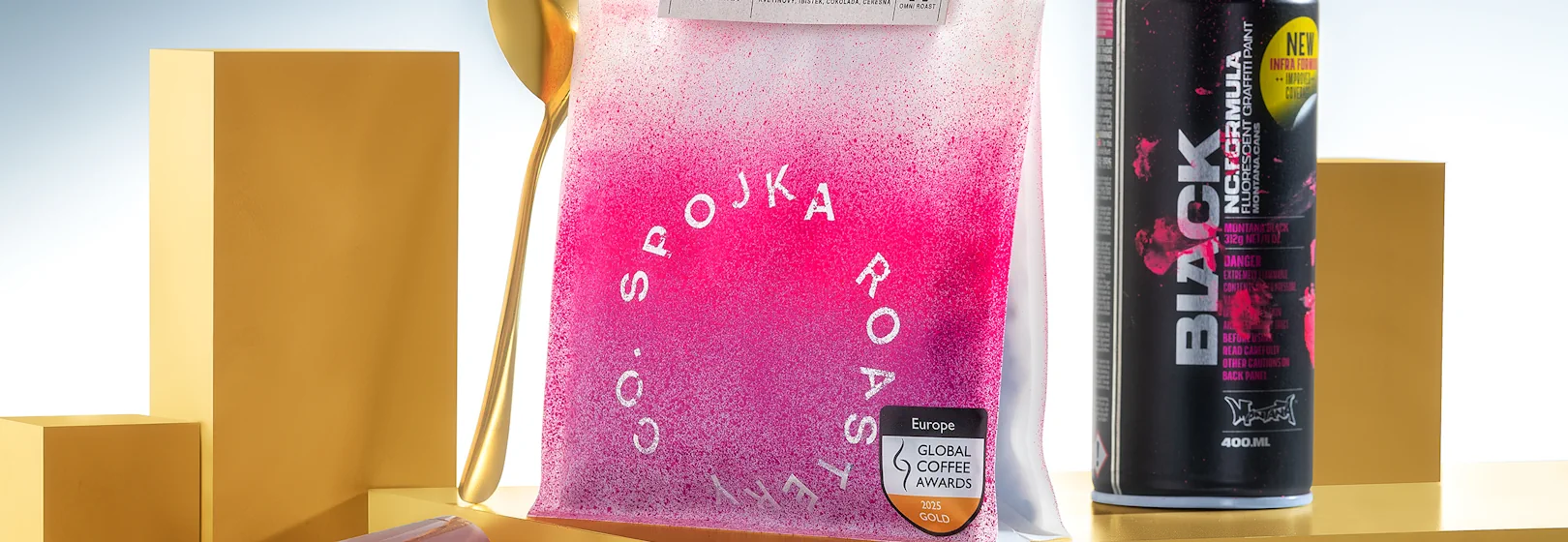
Spojka, for example, utilises bright colours in unique applications to make its packaging unmistakably identifiable; Viktor and Spojka’s sales & marketing manager Eva Srvátková personally spray-paint each bag with streaks of colour that allude to graffiti art – a nod to Viktor’s interests and hobbies.
“I still skateboard, and I grew up surrounded by street culture, music, skateboarding, graffiti, and community. It all shaped me,” he explains. “The energy connects people from entirely different worlds. Street art and skateboarding are universal languages everyone can understand, even if we speak different ones.
“Through design, we express Spojka’s DNA: a mix of street culture, art, and specialty coffee. That’s what makes people recognise us instantly,” he adds.
Spojka’s emphasis on bold, bright colours earned it the MTPak Packaging Award at the European Global Coffee Awards, recognising exceptional design and innovation.
“‘Brewtiful People’ isn’t just a slogan; it’s our identity,” Viktor says. “We collaborate with local designers and keep things raw, honest, and full of character.”
Through Spojka’s packaging and merch, Viktor relays the buzzing energy of skateboarding community spots he grew up in. The roaster’s merch is designed to both celebrate and be worn by the skateboarding community; its caps and beanies are styled for the skatepark, and Spojka collaborated with local brand Tlakers to create a custom deck.
“Inspiration comes from walls, stickers, and streets, not from offices or marketing agencies,” he adds.

Balancing creativity and authenticity
Innovation in coffee packaging and merchandising offers roasters the opportunity to be truly original and inventive, and to connect with their audience in new ways.
With this in mind, roasters must balance staying relevant and true to their core audience while attracting more customers. Successful coffee packaging and merch simultaneously align with the brand’s values and personality while demonstrating that the roaster is adaptable, dynamic, and able to tap into trends in ways that serve their customers.
Striking this balance entails careful consideration of organic, authentic designs.
“Authenticity builds trust. People can sense when something feels fake or overly polished,” Viktor says. “Our packaging and merch have to feel like a natural extension of who we are, not just a sales tool.
“When someone holds a bag of Spojka, I want them to feel the real passion and community behind it, not just see another product.”
The passion behind Spojka – which means “connection” in Slovak – is its mission to bring roasters, baristas, and consumers together across Slovakia, Poland, Romania, and beyond through coffee.
“Through pop-ups, collaborations, and festivals, we’re building a community that’s open, creative, and full of positive energy,” Viktor says. “We want to show that Eastern Europe has its own strong voice in the global coffee scene.”

Strategic packaging and merchandise design choices can significantly impact consumer behaviour and perceived brand value. However, these tactics are only effective when they authentically reflect a roaster’s identity.
In a market where differentiation is increasingly difficult and margins are constantly under pressure, investing time, effort, and creativity into packaging and merch has become an essential strategy.
Enjoyed this? Then read our article on why coffee quality alone is no longer a differentiator for roasters.
Photo credits: Spojka Roastery, Dušan Holovej, Vlastimil Slávik
Perfect Daily Grind
Please note: Spojka Roastery is a sponsor of Perfect Daily Grind.
Want to read more articles like this? Sign up for our newsletter!
Mel is a freelance writer based in Los Angeles zeroed in on coffee and agriculture. She aims to amplify the voices of farmers and a diversity of perspectives. She has an M.S. from U.C. Davis in International Agricultural Development and a B.A. from Occidental College in Biology.